
A Practical Guide to Putting It to Work
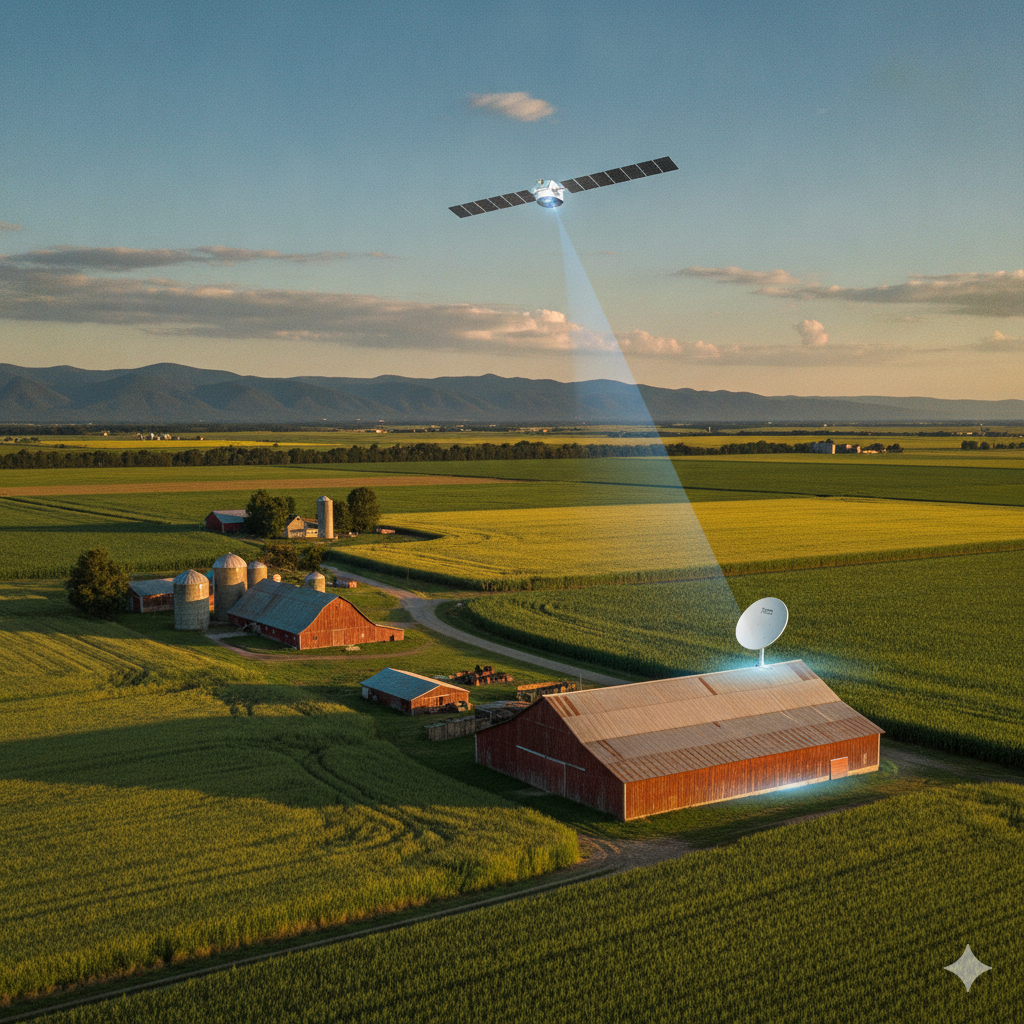
Starlink can be a perfect match for farms and small businesses – but do it the right way — read on…
For most of its history, running a business from a rural location meant accepting a fundamental competitive disadvantage: the internet connection that urban and suburban businesses took for granted simply was not available to you. Cellular data was the best many rural operators could do, and while it served for basic communication, it buckled under the demands of modern business software, video conferencing, cloud-based point-of-sale systems, remote monitoring, and the dozen other connectivity-dependent tools that have become standard operating infrastructure for businesses of every size.
Starlink removed that disadvantage. For small businesses, farms, and ranches operating in areas that terrestrial broadband never reached, it represents the first genuinely capable internet connection many have ever had — not a workaround, not a compromise, but actual broadband that competes with what their urban counterparts use every day.
This post is a practical guide to deploying Starlink in a small business or agricultural operation: what the service can realistically do for you, how to set it up properly for a working environment, what the limitations are, and how to get the most out of it across the specific use cases that matter to farms, ranches, and rural businesses.
Who This Post Is For
The scenarios this post addresses are deliberately broad because the category of rural small business is itself broad. The relevant use cases include:
A farm or ranch operation using connectivity for precision agriculture tools, livestock monitoring, equipment telematics, and administrative work
A rural retail business — feed store, equipment dealer, rural co-op — that needs reliable point-of-sale, inventory management, and customer-facing connectivity
A rural professional services operation — accountant, attorney, consultant, healthcare provider — working from a rural office or a home office on a rural property
A rural lodging or hospitality business — guest ranch, hunting lodge, rural bed and breakfast, vacation rental — that needs to provide guest Wi-Fi and manage bookings online
A rural contractor or service business operating from a rural base and needing reliable communication and cloud access
An agricultural operation integrating precision farming technology, drone operations, or automated equipment that depends on connectivity
The common thread is a legitimate business need for reliable internet that rural infrastructure has historically been unable to meet. Starlink addresses that need directly.
Choosing the Right Starlink Plan for Business Use
Before discussing deployment, it is worth spending time on plan selection, because the standard residential plan is not necessarily the right choice for a business application and the differences are meaningful.
Starlink Residential
The standard residential plan is what most subscribers start with. It delivers solid performance for typical usage but operates on a best-effort basis — during periods of network congestion in your area, speeds can vary. For a sole proprietor or a farm family using connectivity primarily for administrative tasks, email, and occasional video calls, residential service is often entirely adequate and represents the most cost-effective option.
Starlink Business
Starlink offers a dedicated business tier that provides priority data access, higher throughput allocations, and a service level more appropriate for operations where connectivity is mission-critical. The hardware that ships with the business tier is also different — the antenna and router are designed for higher sustained throughput demands.
Business tier pricing is significantly higher than residential, and whether the premium is justified depends on how critical continuous connectivity is to your specific operation. For a ranch where the internet is primarily used for email and occasional video calls between field operations, residential is likely sufficient. For a rural business processing customer transactions, running cloud-based inventory systems continuously, or managing multiple simultaneous users throughout the business day, the business tier’s priority access and higher throughput allocation provide meaningful reliability advantages.
Starlink Priority Data
Even within plan tiers, Starlink offers priority data options that ensure your traffic is deprioritized less frequently during congestion. For business-critical applications this is worth understanding before you lock into a plan, particularly if your operation is in an area with growing Starlink subscriber density.
The honest recommendation is to start with residential service, evaluate its performance under your actual business workload for thirty to sixty days, and upgrade if you find congestion-related performance issues during your busiest periods. Many rural operators find residential service fully adequate for their needs. Others discover quickly that their usage pattern benefits from priority access.
Network Architecture for a Business or Farm Operation
A business deployment is fundamentally different from a residential installation in one important respect: reliability requirements are higher and the consequences of downtime are real. A dropped video call at home is annoying. A dropped payment transaction at a point-of-sale terminal during a busy Saturday is a business problem. A failed remote sensor that was supposed to alert you to a water system failure in a livestock barn is potentially a serious operational problem.
This means the casual approach to network architecture that works fine at home — plug in the router, connect to Wi-Fi, done — is not sufficient for a business context. You need to think about redundancy, wired connections for critical systems, and separation between operational and guest traffic.
Bypass Mode and a Business-Grade Router
As covered in our router placement post, putting Starlink into bypass mode and running your own router gives you meaningful additional control over your network. For a business deployment, this is not optional — it is the correct approach.
A business-grade router or a prosumer router with business-class features — TP-Link Omada, Ubiquiti UniFi, or similar — gives you capabilities that consumer routers do not: VLAN segmentation, detailed traffic monitoring, granular firewall rules, robust port forwarding, QoS prioritization, and centralized management of multiple access points across a large property.
For a farm or ranch with buildings spread across a significant area, a managed wireless access point system — where multiple access points across the property are managed from a single controller interface — is the appropriate architecture. This is what the Ubiquiti UniFi ecosystem and the TP-Link Omada ecosystem are designed for, and both work well with Starlink in bypass mode.
Wired Ethernet for Critical Systems
Any system that is genuinely business-critical — point-of-sale terminals, desktop computers running business software, network-attached storage, monitoring system hubs — should be connected via Ethernet cable rather than Wi-Fi where physically possible. Wired connections are more reliable, more consistent in throughput, and less susceptible to interference than wireless. The few extra steps of running cable to critical systems pays dividends in operational reliability.
VLAN Segmentation
A VLAN — Virtual Local Area Network — allows you to divide your physical network into separate logical networks that cannot directly communicate with each other. For a business deployment, this is valuable in several ways:
Guest Wi-Fi isolation. If you provide Wi-Fi to customers, guests, or visitors — a common need for rural hospitality businesses, waiting areas in a rural professional office, or a farm store — you want that traffic completely isolated from your operational network. A guest on your Wi-Fi should not be able to access your bookkeeping software, your point-of-sale system, or your farm management tools. VLAN segmentation enforces this separation at the network level regardless of what a guest tries to do.
IoT device isolation. Farm sensors, livestock monitoring devices, cameras, smart equipment, and other IoT devices should be on their own network segment, isolated from computers running financial and business software. IoT devices have notoriously inconsistent security practices and represent a potential vulnerability if they share a network with sensitive business systems.
Operational vs. administrative separation. Separating the network segment used by equipment controllers, automation systems, and monitoring infrastructure from the one used by office computers is good security hygiene and prevents operational traffic from competing with administrative traffic for bandwidth.
Cellular Backup
For any business where connectivity is mission-critical, a cellular backup connection provides resilience against Starlink outages. Starlink’s service has improved dramatically and outage frequency is low for most subscribers, but no single connection is 100 percent reliable, and the brief interruptions that are a normal characteristic of Starlink service are more consequential in a business context.
A 4G or 5G cellular router as a backup WAN connection — configured to automatically fail over to cellular when the Starlink connection drops — provides meaningful business continuity. Many business-grade routers support dual-WAN failover natively. The cellular connection does not need to be a high-capacity plan — it just needs to be reliable enough to handle critical traffic during the periods when Starlink is temporarily unavailable.
Farm and Ranch Specific Applications
The agricultural sector has developed an extensive ecosystem of connectivity-dependent tools that become genuinely useful when reliable broadband finally arrives at the operation. Here is a practical overview of the most valuable categories.
Precision Agriculture and Telematics
Modern farm equipment from major manufacturers — John Deere, Case IH, New Holland, and others — includes telematics systems that transmit operational data including machine location, operating parameters, fault codes, and field coverage data to cloud-based farm management platforms. These systems assume a reliable internet connection at the farm headquarters and increasingly at the field level.
With Starlink, farm managers can monitor machine performance and location in real time, receive fault alerts before they become breakdowns, track input applications for compliance and documentation, and analyze field-level performance data that was previously difficult to access from a rural location.
Variable rate application systems, automated guidance, and field mapping tools all benefit from reliable connectivity for data upload and software updates. Operations that previously struggled to maintain software currency on precision agriculture equipment because downloading large updates over a slow connection was impractical now have no such barrier.
Livestock Monitoring
The livestock monitoring technology space has expanded considerably in recent years and much of it depends on connectivity. Current offerings include:
Individual animal tracking and health monitoring. Ear tag and bolus-based sensors from companies including Allflex, SCR, and others track individual animal movement, rumination, eating behavior, and temperature, generating alerts when an animal’s behavior deviates from baseline in ways that indicate illness, heat, calving proximity, or other significant events. These systems require a reliable connection to cloud-based analytics platforms that interpret the raw sensor data.
Environmental monitoring for barns and confined facilities. Temperature, humidity, ammonia levels, and ventilation performance monitoring for poultry houses, swine facilities, and dairy barns connects to cloud-based dashboards and generates alerts when conditions fall outside acceptable parameters. The value of receiving an alert on your phone at 2 AM that a ventilation fan has failed in a poultry house, before significant losses occur, is immediately apparent to anyone who has experienced a ventilation failure without such warning.
Water system monitoring. Remote monitoring of water tank levels, pump operation, and trough condition allows ranch managers to detect failures and water shortages in remote pastures without physical inspection. On a large ranch where checking every water source requires significant travel time, automated monitoring with alerts delivered over Starlink connectivity represents a meaningful operational efficiency.
Calving and lambing cameras. High-resolution cameras in calving barns monitored remotely via a smartphone or tablet — rather than requiring physical nighttime checks in bad weather — have become a standard tool on well-equipped cattle and sheep operations. These cameras require reliable connectivity to stream video to a monitoring device, and Starlink’s bandwidth handles this comfortably.
Drone Operations
Agricultural drone use for crop scouting, spraying, and mapping has grown significantly. Reliable internet connectivity supports several aspects of drone operations: uploading and downloading flight plans, accessing field maps and prescription data, transmitting scouting imagery to agronomists for remote analysis, and maintaining software currency on drone flight controllers.
Some precision spraying and mapping operations also benefit from real-time connectivity to correction services for GPS accuracy. While dedicated RTK correction networks exist for this purpose, having reliable internet connectivity at the farm supports the data management workflow around drone operations even where the drone itself operates independently of the internet connection.
Grain Marketing and Agricultural Software
Farm financial management, grain marketing, crop insurance management, and agricultural record-keeping software are now predominantly cloud-based. Reliable broadband makes these tools as accessible from a rural farm office as from an urban location — access to real-time commodity prices, futures data, weather forecasting, agronomic advisory services, and digital record-keeping platforms that once required a trip to town or a phone call to an advisor.
For operations that sell grain, cattle, or other commodities, the ability to monitor markets and respond to pricing opportunities in real time from the farm has real financial value. Missing a favorable pricing window because you could not load a market platform on a slow connection is a problem Starlink eliminates.
Rural Hospitality and Guest Services
Guest ranches, hunting lodges, rural bed and breakfast operations, and vacation rental properties face a specific connectivity challenge: they need to provide guest Wi-Fi that meets modern traveler expectations while protecting their own operational network.
Guest Wi-Fi Expectations
Travelers — even those choosing a rural experience — arrive with multiple connected devices and an expectation of functional internet access. A hunting lodge that could not previously offer anything beyond spotty cellular service can now provide the kind of Wi-Fi that actually satisfies guests. This is increasingly a competitive differentiator for rural hospitality businesses, because the segment of the market that values remote experiences has not stopped expecting connectivity.
Starlink’s bandwidth is sufficient for multiple simultaneous guest users engaging in typical travel behaviors — checking email, social media, streaming video in the evenings, video calling family members. The key is proper network architecture: a guest VLAN isolated from operational systems, access points positioned to cover guest accommodation areas, and appropriate QoS settings that prevent any single heavy user from degrading the experience for others.
Booking and Property Management Systems
Online booking platforms, property management software, and channel management tools that synchronize availability across booking platforms are all cloud-based and require reliable connectivity to function correctly. For a rural lodging business that previously relied on phone bookings because the internet was too unreliable for online platforms, Starlink enables the fully online booking and management workflow that modern hospitality operations depend on.
Point-of-sale systems at a ranch store, gift shop, or dining operation similarly require reliable connectivity for payment processing, inventory management, and end-of-day reconciliation. Starlink’s reliability makes these systems viable at rural locations where cellular payment processing was previously unreliable.
Remote Staff Management
Rural hospitality businesses often employ staff across a spread-out property and benefit from digital tools for scheduling, communication, and task management. These tools — everything from basic messaging platforms to dedicated hospitality management software — function correctly when the underlying internet connection is reliable. Starlink makes this practical in a way that slow or unreliable cellular connections do not.
Rural Professional Services and Home Office Use
Rural attorneys, accountants, healthcare providers, consultants, and other professionals working from rural offices or rural home offices face specific requirements that Starlink addresses directly.
Video Conferencing
The shift toward video-based client communication that accelerated during and after the pandemic is permanent. Rural professionals who serve clients remotely — or who work as part of distributed organizations — need video conferencing that is reliable and of sufficient quality that it does not undermine professional credibility. Starlink’s latency profile, while higher than fiber or cable, is low enough for entirely functional video conferencing. The specific numbers — typically 25 to 60 milliseconds round-trip — are below the threshold where participants notice perceptible delay in natural conversation.
The important nuance is that Starlink’s latency is variable rather than perfectly consistent. Brief spikes during satellite handoffs can cause momentary audio or video artifacts. In practice, this is noticeable occasionally and is not the kind of problem that derails a professional interaction. It is worth being aware of and factoring into expectations, but it is not a barrier to professional video conferencing use.
Cloud-Based Business Software
Accounting software, legal practice management platforms, electronic health records, CRM systems, and virtually every other category of professional software has migrated to cloud-based delivery. These systems assume a reliable broadband connection and are degraded or non-functional on the kinds of connections that rural professionals previously had to work with. Starlink makes these tools function as intended.
VPN for Remote Corporate Access
Rural professionals who work as employees of larger organizations typically need VPN access to corporate systems. As covered in our VPN post, Starlink is compatible with standard VPN configurations. The latency characteristics of Starlink add modest overhead on top of the baseline VPN latency, but for the document access, email, and application use that characterizes most remote corporate work, this is not a material barrier.
Security Considerations for Business Deployments
A business network carries more sensitive data and represents a higher-value target than a typical residential network. A few security considerations deserve specific attention in a rural business deployment.
Physical Security of Network Equipment
Rural business locations sometimes have less physical security than urban ones. The router, switches, and access points that make up your network represent both replacement cost and, if physically compromised, potential network access. Mount network equipment in locked enclosures or secured locations where practical, particularly in outbuildings or locations accessible to employees, contractors, or visitors who should not have administrative access to the network.
Firmware and Software Currency
Keep the firmware on your router, access points, and network switches current. Security vulnerabilities in networking equipment are regularly discovered and patched by manufacturers, and running outdated firmware is an unnecessary exposure. Business-grade networking platforms from Ubiquiti, TP-Link Omada, and similar vendors provide centralized firmware management that makes this straightforward to maintain.
Password and Access Management
Business networks should use WPA3 encryption where supported, strong unique passwords for each network segment, and changed default administrative credentials on every piece of networking equipment. These are basic hygiene practices that a surprising number of small business networks skip. A rural location does not mean a low-risk network environment — internet-facing threats are geography-independent.
Backup and Data Protection
If your business systems store data locally — on a server, a NAS, or desktop computers — ensure that data is backed up off-site. Cloud backup services are now practical over Starlink where they were not over previous rural connections, and the availability of a reliable connection to a cloud backup service is itself a meaningful business continuity improvement that Starlink enables.
Managing the CGNAT Limitation in a Business Context
As covered in previous posts in this series, Starlink uses CGNAT — Carrier Grade Network Address Translation — which means your connection does not have a dedicated public IP address. For some business use cases, this limitation is relevant.
Point-of-sale and payment processing do not require a public IP address and are unaffected by CGNAT. These systems make outbound connections to payment processors and function correctly behind CGNAT.
Remote monitoring platforms for farm equipment, livestock monitoring, and environmental sensors are almost universally designed to operate behind CGNAT — sensors and monitoring devices make outbound connections to cloud platforms rather than requiring inbound connections from the internet.
Remote access to on-site systems — accessing a security camera system, a network-attached storage device, or a workstation from outside the property — traditionally relies on port forwarding, which does not work behind CGNAT. The correct solution for this use case is a tool like Tailscale, which creates an encrypted mesh network between your devices that traverses CGNAT transparently. We covered Tailscale in detail in our VPN post. For business users needing reliable remote access to on-site systems, Tailscale is the practical answer to CGNAT.
Dedicated IP address add-on — Starlink has made a dedicated IP address available as an add-on for business subscribers in some markets. This resolves the CGNAT limitation entirely for operations where a public IP is genuinely necessary for business function. Check current Starlink business plan offerings in your region for availability.
Redundancy and Business Continuity
For operations where connectivity is mission-critical, a single Starlink connection — however good — is insufficient as a business continuity strategy. Hardware can fail, the dish can be damaged, and brief service outages, while infrequent, do occur.
A practical business continuity approach for a rural operation includes:
Cellular failover as described earlier — a 4G or 5G cellular router on a separate data plan, configured as a secondary WAN connection that activates automatically when the Starlink connection drops.
A spare router — if your third-party router fails, you want to be back online in minutes with a replacement, not waiting for shipping. Keeping a spare router configured and ready at the location is inexpensive insurance for a business that depends on connectivity. When it comes to routers, don’t think consumer level. Think business. Ubiquiti has what you need.
UPS protection for all networking equipment — covered in depth in our power protection post. Brief power interruptions should not cause network outages, and proper UPS coverage ensures they do not. Don’t skimp here. Use a reliable brand. My favorite is APC, an industry leader. Click here for the APC product family.
Critical operations that can function offline — for any truly mission-critical business process, understanding what happens if connectivity is unavailable for an hour and designing that process to handle the offline scenario gracefully is good operational planning regardless of how reliable your connection is.
The Realistic Expectation: What Starlink Changes and What It Does Not
Starlink delivers a genuinely transformative connectivity upgrade to rural businesses and agricultural operations that previously had no viable broadband option. But it is worth being clear-eyed about what it changes and what it does not.
What it fundamentally changes is the availability of adequate bandwidth for modern business tools. Cloud software, video conferencing, telematics platforms, livestock monitoring systems, and remote management tools that previously required a broadband connection now work reliably at rural locations. This is not a small change — for many rural operators it removes the single largest practical barrier to using the same tools their urban and suburban competitors use every day.
What it does not change is the latency physics of satellite communication. Starlink’s latency is real and is higher than a fiber or cable connection. For the overwhelming majority of business applications this is not a material issue. For a small number of latency-sensitive applications — real-time financial trading, certain VoIP configurations, competitive online gaming — it remains a relevant limitation.
What it also does not change is the fundamental operating environment of a rural business or agricultural operation. Connectivity is an enabling tool, not a substitute for the other things that make a farm, ranch, or rural business succeed: sound management, good equipment, capable people, and sound financial practices. Starlink adds a capability that rural operators previously lacked. What they do with it is, as always, up to them.
Final Thoughts
The rural small business and agricultural sector represents one of the most compelling use cases for Starlink, precisely because the delta between what these operations previously had and what Starlink delivers is so large. A suburban household upgrading from cable to Starlink is a modest improvement. A remote ranch operation going from unreliable cellular to Starlink broadband is a fundamentally different kind of change.
Done right — with appropriate hardware, thoughtful network architecture, and realistic expectations — a Starlink deployment at a rural business or agricultural operation pays for its hardware and monthly service cost many times over in operational capability, time savings, and access to tools and markets that reliable connectivity enables.
If you are a rural operator who has been tolerating a poor internet connection because you assumed nothing better was available, that assumption is now outdated. The connection your urban competitors take for granted is available to you. The question is how well you put it to work.


